Issue
Recently I met an kretporbe performance issue on our prod environment.
We want to use kretprobe to hook for function ipt_do_table() in kernel to get the return value, which is a verdict to indicate whether the packet be ACCEPT, DROP or STOLEN by iptables.
But after the eBPF program deployed, some of the nodes has high SI usage.
%Cpu(s): 11.8 us,  4.7 sy,  0.0 ni, 49.3 id,  0.0 wa,  0.0 hi, 34.2 si,  0.0 st
MiB Mem : 385361.6 total, 212019.8 free, 122891.7 used,  50450.0 buff/cache
MiB Swap:      0.0 total,      0.0 free,      0.0 used. 260467.6 avail Mem
Ping latency can up to 100ms sometimes
Check for what CPU is busy for
From the flame graph, we can see that the CPU is busy handing the kretprobe hooks.
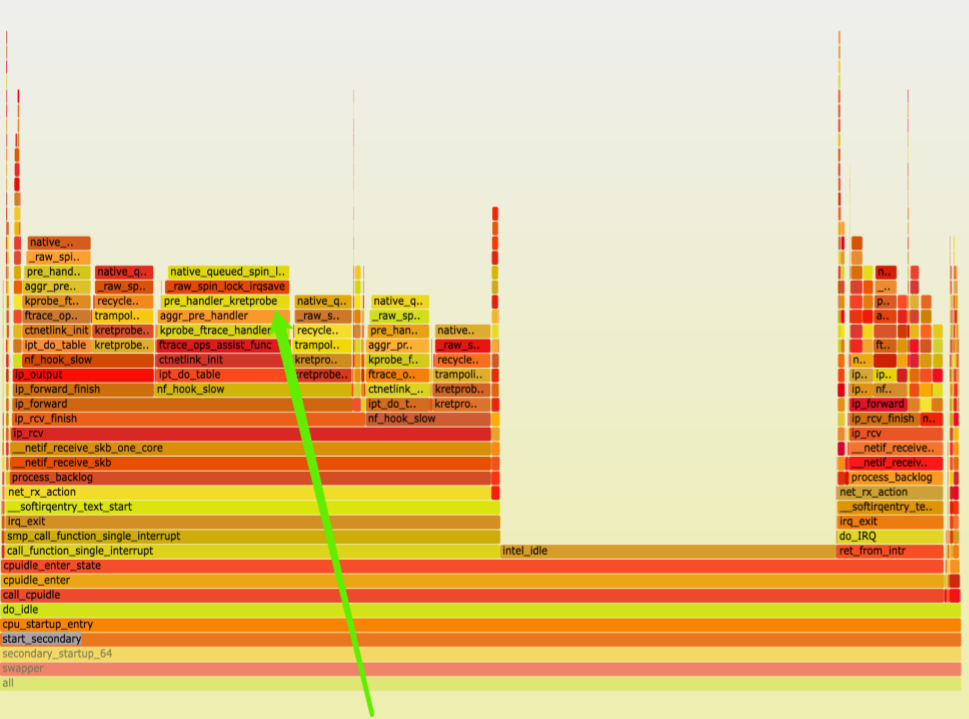
We are using ubuntu 20.04 and which is 5.4.0 kernel.
In function pre_handler_kretprobe(), it will
- get a free instance, and bind the instance with the current task
- execute the handler and then free the instance.
- call arch_prepare_kretprobe to replace the return value in reg.
/*
 * This kprobe pre_handler is registered with every kretprobe. When probe
 * hits it will set up the return probe.
 */
static int pre_handler_kretprobe(struct kprobe *p, struct pt_regs *regs)
{
	struct kretprobe *rp = container_of(p, struct kretprobe, kp);
	unsigned long hash, flags = 0;
	struct kretprobe_instance *ri;

	/*
	 * To avoid deadlocks, prohibit return probing in NMI contexts,
	 * just skip the probe and increase the (inexact) 'nmissed'
	 * statistical counter, so that the user is informed that
	 * something happened:
	 */
	if (unlikely(in_nmi())) {
		rp->nmissed++;
		return 0;
	}

	/* TODO: consider to only swap the RA after the last pre_handler fired */
	hash = hash_ptr(current, KPROBE_HASH_BITS);
	raw_spin_lock_irqsave(&rp->lock, flags);
	if (!hlist_empty(&rp->free_instances)) {
		ri = hlist_entry(rp->free_instances.first,
				struct kretprobe_instance, hlist);
		hlist_del(&ri->hlist);
		raw_spin_unlock_irqrestore(&rp->lock, flags);

		ri->rp = rp;
		ri->task = current;

		if (rp->entry_handler && rp->entry_handler(ri, regs)) {
			raw_spin_lock_irqsave(&rp->lock, flags);
			hlist_add_head(&ri->hlist, &rp->free_instances);
			raw_spin_unlock_irqrestore(&rp->lock, flags);
			return 0;
		}

		arch_prepare_kretprobe(ri, regs);

		/* XXX(hch): why is there no hlist_move_head? */
		INIT_HLIST_NODE(&ri->hlist);
		kretprobe_table_lock(hash, &flags);
		hlist_add_head(&ri->hlist, &kretprobe_inst_table[hash]);
		kretprobe_table_unlock(hash, &flags);
	} else {
		rp->nmissed++;
		raw_spin_unlock_irqrestore(&rp->lock, flags);
	}
	return 0;
}
NOKPROBE_SYMBOL(pre_handler_kretprobe);
There are raw_spin_lock_irqsave called to acquire lock for rp->lock, which is a gloabl lock for that retprobe.
That should be the reason for why it has poor performance.
Improvement
Checked for 5.15 kernel, the implementation for the list and been changed to be lockless.
/*
* This kprobe pre_handler is registered with every kretprobe. When probe
* hits it will set up the return probe.
*/
static int pre_handler_kretprobe(struct kprobe *p, struct pt_regs *regs)
{
struct kretprobe *rp = container_of(p, struct kretprobe, kp);
struct kretprobe_instance *ri;
struct freelist_node *fn;
fn = freelist_try_get(&rp->freelist);
if (!fn) {
rp->nmissed++;
return 0;
}
ri = container_of(fn, struct kretprobe_instance, freelist);
if (rp->entry_handler && rp->entry_handler(ri, regs)) {
freelist_add(&ri->freelist, &rp->freelist);
return 0;
}
arch_prepare_kretprobe(ri, regs);
__llist_add(&ri->llist, ¤t->kretprobe_instances);
return 0;
}
NOKPROBE_SYMBOL(pre_handler_kretprobe);
solution
- Upgrade kernel to make fexit() supported, and use fexit() instead of kretprobe()
- Add a tracepoint to the ipt_do_table function, then use raw_tracepoint instead of kretprobe After load test. Compare with kreprobe/kprobe, raw_tp and tp perroamnce are much more better.